Over the last six months, I have been talking and learning as much as possible regarding artificial intelligence. I use a large language model daily to assist me in my consultancy business, but I have many thoughts about AI-based shopping/commerce. Shopping is an inherently social experience, and e-commerce has already made it more transactional. What will agents and AI models do to it?
As I write this in July 2025, artificial intelligence is being driven by incumbents such as Amazon, Microsoft, and Meta, as well as startups like OpenAI and Anthropic. These businesses have three key ingredients required to offer AI at scale: cloud platforms that provide processing power, large language models (LLMs), and applications that enable inference to create results from consumer prompts.
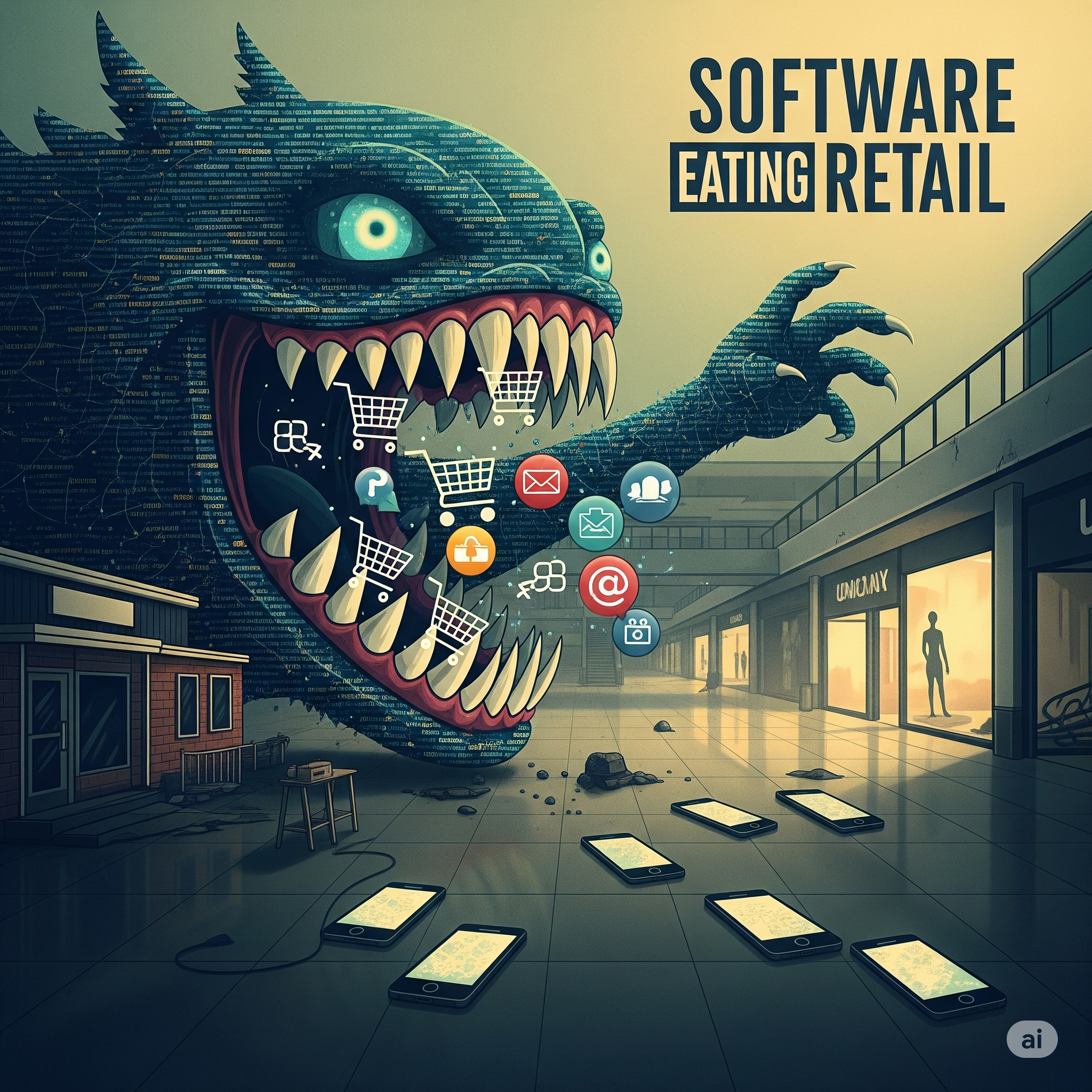
Image created with a prompt “software eating retail”
History Repeating Itself
I have read that in 1999, entrepreneurs believed that they would replace retail with e-commerce. Twenty-six years later, it feels like online search is in a similar position. I have to ask, is that a case of history repeating itself? I simply have to look at emerging markets. Retail remains the primary purchase place for customers.
I sit in the middle of the world, and I must say the difference between the US and China regarding AI and commerce is stark. China made cross-border e-commerce a national priority in 2024, but Alibaba and other technology companies are building AI tools to complement their platforms or offer services to businesses and industries. In the US, there is no national policy on AI, and it feels like investors and platforms are driving this conversation. Can I call it a land grab when only incumbents can win in a new market?
Bots, Agents, and Models
Every business or platform now wants to offer its customers a bot that can help them with questions. The question should be – should we offer this to our customers? Customers can use these bots to answer simple questions, but the experience can become redundant when the bot uses links or articles that the customer has already used pre-contact. These tools are currently usable for basic queries, but humans are needed for complex questions or issues.
All of these solutions are dependent on data, and if you have been in commerce for years, the dirty secret is that product data is not a priority for most businesses. So, based on what, do these models and agents recommend products to their users? There is a lack of alignment between customers and their LLMs/agents that are unlikely to change soon, as these models have not had enough time to learn about their users’ needs or wants. We will likely see an industry develop that helps brands have their products found by these various models, and how does that benefit brands?
Brands currently have no idea how these agents are accessing their content and how that impacts their systems. I have heard stories of apps and agents that are adding impressions to analytics, yet there is no conversions happening.
The buzzword for 2025 is agentic. Everything under the sun can now be done by agents, but how does this work in the commerce sector? Machine-to-machine connections via a browser, but then it falls off a cliff as payments need a human to enable payments, and these agents are likely to be seen as fraud by payment processors. So it’s a fundamental shift that is required, and I have not mentioned the lack of trust that this whole process has. Did I mention that Amazon is blocking all LLMs from accessing their products and content?
Early Vertical Specific Agents
I had previously written about Daydream and was eager to see their beta, but I left disappointed. I have also played with Gensmo, and I left wondering why, after reportedly raising over $110 million combined, these companies are reinventing affiliate commerce.
What challenges do Daydream and Gensmo address as first-to-market solutions? Name me the problem, as I do not see it.
The Deal Is What?
We are noticing that on Google search, as it transitions from a search engine to an answer engine, organic content is shifting. Clicks are down and unlikely to return. Can anyone tell me how paid search marketing is now occurring and its impact on brands? Is this an admission by Google that its search engine has plateaued and that it’s really concerned about OpenAI and others? Or is this yet another black box that is added to the search sector?
A few weeks ago, Rick Watson mentioned that there will be cannibalization due to AI. I am yet to see any new LLMs that are creating new audiences or new opportunities for brands. I believe this situation is an analogy for the relationship between retail and e-commerce. Agent and LLM-based commerce will be another channel for brands to optimize for, but it will not replace e-commerce as we know it. Amazon has added Rufus to its app as a way to gain more data from consumers, to help learn more about habits.
As of July 2025, the best use case for artificial intelligence is B2B, and we are nowhere close to having product-market fit for B2C solutions.
We have a sector that is being pushed by incumbent platforms, and consumers have multiple methods to acquire products. The lack of alignment between users and their LLMs will lead to consumers questioning their use and the relevance of the results. Commerce requires a variety of steps, from discovery to purchase, which are currently handled by humans.
In summary, software has not eaten retail. AI commerce is still a while before its valuable.