Category: Business

  • Direct to customer startups partnering with Target, Nordstrom and Amazon?

    When I compiled my newsletter over the weekend – I added a new section to it. Direct to customer ecommerce is something that stumbled across and have over the last few months looked at in depth. However these direct to customer businesses are now using Target, Nordstrom and Amazon as a channel to reach new customers. This is a double sided agreement as the startups involved (Harry’s, Bevel and now Casper) are providing these older businesses with the opportunity to access a new customer base.

    Ecommerce is at a cross roads

    If your business is not called Amazon, ecommerce is increasingly becoming more complex as customers demand Amazon like experiences (shipping and customer service) and that requires investment both in people and capital. Investors are also more looking at these direct to customer startups as they are ultimately margin businesses at scale. Instead of spending X on a product and selling it via multiple channels that take their own commissions these business are going straight to the customer and passing on that savings directly to the customer.

    After Dollar Shave Club was acquired by Unilever for a billion dollars the signs were clear – niche specific startups with founders that have deep domain experience creating great products are reasonable prices are the future. There is only one giant that can slow down Amazon and that is Walmart due to its scale and potential to invest in providing customers with pricing similar to that seen on Amazon.

    Continue Reading

  • Sync Everything with Skubana

    When I think of e-commerce, there are essentially two parts to it. The first is the lovely and beautiful UX of product pages and shopping carts that buyers use to purchase items from online retailers. The second is the tremendous amount of systems behind this UX that ensure the buyers actually receive the products they order.

    And it is this backend infrastructure that is the major pain point for e-commerce sellers today. Just think of all that sellers can (and usually must) do to fulfill orders and run their business.

    1. Channel Integration – most e-commerce retailers sell on multiple sales channels (Amazon, eBay, Magento, Shopify, etc.), which means they need tools to communicate with those channels.
    2. Order Processing – whether shipping orders from their own warehouse, outsourcing fulfillment to a 3PL center, or drop shipping products directly from their vendors, sellers must rely on a myriad of software platforms to deliver their products to customers.
    3. Inventory Management – as orders come in, products leave the warehouse, and the challenge of synchronizing inventory across all channels becomes a huge headache because none of the channels communicate with each other.
    4. Purchasing – as soon as sellers start running low on inventory, they rely on purchase orders to their vendors to replenish stock.
    5. Accounting and Analytics – e-commerce is a tremendously competitive space, and unless a seller can keep track of their expenses and analyze sales data, they will likely get outperformed by the competition.

    If the list above sounds complicated, it’s because it is. There are 5 million (and growing) small and medium e-commerce sellers in the U.S. alone that currently struggle to process their orders and manage inventory because they have to piece together a hodgepodge of software solutions to run their business. These are serious pain points that cause sellers to lose thousands of dollars each year due to overselling and being under-stocked.

    One of those sellers is Chad Rubin, a very successful owner of the e-commerce company CrucialVacuum. While I was in the U.S. in October I caught up with Chad, and to my surprise found out that he might have the answer to the woes that plague e-commerce sellers today. The name is Skubana, and it is Chad’s latest and without a doubt greatest endeavor: the world’s first and only all-in-one cloud e-commerce backend platform.

    To create such a revolutionary product, Chad knew he had to team up with the right technical resources.

    Enter D.J. Kunovac, an enterprise architect and engineer who previously developed software for hospital networks while working for McKesson, the largest healthcare company in the world. The two have teamed up to create something no one has dared to try so far in the e-commerce world: an e-commerce unification platform.

    And after seeing the platform in action, I believe that this is a potential game changer.

    Skubana is based in New York and a stone’s throw away from where Quidsi was operating from. Currently Skubana is only focused on the U.S. market and is at the moment doing a private beta with select merchants.

    You can sign up here: http://www.skubana.com/signup

    Skubana has, in my opinion, the ability to democratize a part of the commerce industry that is not big enough for enterprise software, but is too complex for out-of-the-box solutions. They launch in the Spring of 2015, and the world of e-commerce may never be the same again. Stay tuned.

    Disclosure: I received no payment for this post nor have any business interest in Skubana. Chad is someone whom I respect and his business is a part of ecommerce that no platform is looking at. This post is my opinion about a platform that I think can change a lot of things for business owners.
  • The Great Technology War between Giants

    2012 was a year in which a bigger picture formed inside my thinking. Ecommerce is my day job and I think we are in a great period for commerce. Let us be clear about one thing, retail and ecommerce is no longer 2 channels. It is one massive opportunity for businesses and entrepreneurs to assist customers buying items whether it be online or in-store.

    Mobile commerce in its current format is not the endgame in my mind. We are only scratching the surface on what mobile devices can do. Augmented reality, location and a variety of other things will play a role in commerce in the coming years.

    Regular readers will be aware of my thinking regarding the big five. It is not the animals found in the game park but rather the big five technology businesses. I have written about it in the past when I looked at the Amazon effect but these companies drive the technology used by us on a daily basis.

    Continue Reading

  • The 10 e-commerce stories for the week ending 28 December 2012

    Logistics is now a battleground, Apple and Google fighting over mobile, Amazon says a lot but it has no meaning and news from China, India and Malaysia.

    As far as I am concerned 2012 is now in the record books. One working day left until 2013 and all the challenges it brings with it. Let me say this, I am looking forward to 2013 as I think we are in a bumper year of news. I am expecting a tough financial climate from April but in terms of ecommerce I think 2013 is a big year. Do Alibaba IPO? Is Groupon still around in 12 months time and does Rocket Internet have a plan for continued cloning or disruption (I think so, their businesses have raised big capital..).

    If I look back over my posts in the last 12 months (yes, readers I know the content was not flowing the entire year), a few things stand out for me:

    1. Amazon is a freight train that is going into territories that makes a wide range of competitors concerned. I am honest, I think Google and Amazon is going to headline 2013. Bezos wont relent until his creation owns the retail online space. No one is standing between him and the end goal.
    2. eBay is standing at the door and the more I think about what they are doing, the more I think they have potential to be a story for 2013. Their mobile business is going into territories that not many have gone to.
    3. Developing markets are now where the innovation happens. I spent a few weeks outside South Africa that made me realise that there is businesses across the globe pushing boundaries. I cant go into specifics but all I can say, is that ecommerce is now global.
    4. 2012 was the year in which logistics finally made it into the strategy meetings. Yes, I know logistics is only spoken about when things go bad but this past year, it became a battleground for entrepreneurs, retailers and corporates. Investment is going to determine survivors and speedy delivery will become like search on ecommerce business. Same day delivery is going to be expected by default.
    5. Social commerce ended up being zilch. I got sucked into this and I must say social with commerce is either a pipe dream or is not being executed at the moment. ROI for facebook ads for ecommerce businesses most probably raises eyebrows at finance and nothing more. Vanity metrics is becoming commonplace in meetings. Building businesses on another non-owned platform is never a good thing.
    6. The ecommerce business that made 2012 for me is fab.com. I really think that they potentially can be a business to outgrow the pack in 2013. Oh and they get mobile commerce. Starbucks almost got this “award”.
    7. Readers there is a disruptor operating below the radar.. it is called Kickstarter. B2C just got turned upside down and in time I think the concept could be even more fine tuned.
    8. I have a challenge for 2013 and that is to try and spend more time with startups. I met 3 this year and by all accounts, I think they will have a good 2013. There is one in Seattle, that I think will be a disruptor in 2013.
    9. Mobile is and will continue to be the light at the end of the tunnel for ecommerce businesses. There is still lots of thinking to be done about mobile commerce.

    Continue Reading

  • What is under the hood at Zalando.de?

    Amazon.com is well known for creating custom software for their platform due to  scale. Millions of products, transactions and real time pricing and data that is used by Amazon internally ensured that off the shelf software would be totally inadequate. I for one, can only imagine that petabytes of data is consumed in Seattle.

    Generally, technology companies like to keep the opposition guessing. What is under the hood and successful is not shared with the public. Yes, legal will most probably have a heart attack if you share technologies used. Employment contracts ensures that Intellectual Property is protected to the T and any disclosure could lead to immediate termination.

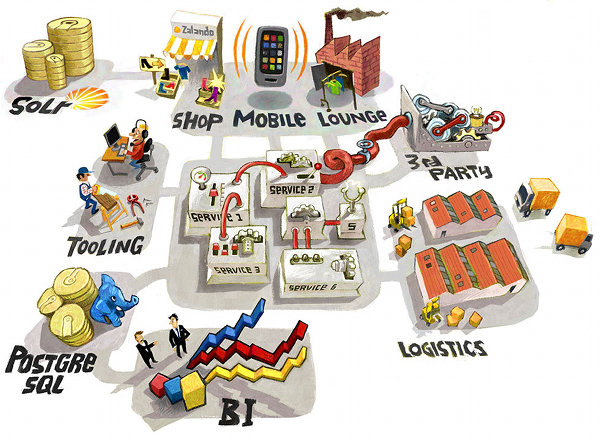
    However, Zalando (the fashion business inside the Rocket Internet Empire) thought they would share their technology by means of an Infographic. To be clear, it provides an idea of the technologies used by the Zalando technology team.

    Big Sales need Big Software. Discover Zalando’s E-Commerce Platform.

    While Zalando is well-known for it’s massive and unique growth as a retailer since 2008, little was known about our technical platform yet. Time to give some insights into how Zalando uses technology and mindset to produce and run excellent, fail-safe and scaling E-Commerce APIs and applications for millions of demanding customers.

    The entire image can be seen here: Zalando Technology (The image is interactive, so when visiting the Zalando Technology website, expect that every division has a roll over)

    Why is this a big deal? Why do you share this kind of information on the same day that investment from J.P. Morgan Asset Management and Quadrant Capital Advisors is announced?

    “The company has quickly established itself as a leading online fashion retailer in Europe. We are impressed with Zalando’s large, growing, and loyal customer base as well as the breadth of products offered on the company’s eCommerce platform. Zalando’s world-class fulfillment resources and dedication to superior customer service should enable the company to expand upon its leading market position.”

    I would think that you keep as much of this inhouse to ensure that you retain the competitive advantage of the technologies used..

    Hat Tip to Exciting Commerce for the highlighting this information on Zalando.