Category: Marketplaces

  • Asymmetrical Information – The case of lemon cars and e-commerce

    According to Investopedia, asymmetrical information or information failure occurs when one party to economic transaction possesses more material knowledge than another party, or they do not have the perfect experience. It typically manifests when the seller possesses greater knowledge than the buyer; however, the reverse dynamic is also possible.

    Asymmetrical information

    A good example of asymmetrical information is the relationship between a seller and a buyer. Whether it is a car salesman, estate agent, or realtor, or a marketplace, specific individuals always have more knowledge about the asset which they are trying to sell to an individual. The unfair advantage is also visible at a macro level on e-commerce as a sector.

    An example of asymmetric information

    Continue Reading

  • The Law of Unintended Consequences

    As 2020 moves forward, I have been thinking about the unintended consequences related to the COVID19 virus. How it will change our lives is currently unclear. The illness has impacted every sector and activity, and unintended consequences are becoming visible globally. The law of unintended consequences is seen as a building block of economics, but it feels relevant to the current situation seen in the world.

    The law of unintended consequences via the impact of regulation and legislation

    Governments have done the right thing to protect citizens, but inadvertently forever changed retail, e-commerce, and commerce.


    Continue Reading

  • Why Farfetch and JD.com need one another

    It is clear to me now that in hindsight the partnership between Farfetch and JD.com is beneficial to both parties for different reasons. As Farfetch is on the road to go public they will face increasing skepticism about their growth versus Yoox-Net-A-Porter.  JD.com is increasingly to position itself as the premium destination for luxury brands in China. The problem for JD.com is that Alibaba is growing faster than them and that Alibaba is using their New Retail concept to provide access to Chinese larger customers.

    Farfetch, announced that JD.com invested $397 million in the business and that JD.com CEO Richard Liu would be joining their board. Farfetch has been making strategic moves to ensure that they can go public with many opportunities and experience in their board and business.  Farfetch will also leverage JD.com’s platform to create a Chinese path for customers to purchase fashion products.

    By investing almost $400 million into Farfetch, JD.com gets a hedge against their own future. Battling Alibaba in China leads to investments into logistics and advertising to ensure that JD.com can grow against a giant marketplace.

    JD.com & Farfetch

    (more…)

  • Should Amazon be doing more regarding Tax Nexus in the US?

    Let me start off by saying that I am not an accountant nor a financial professional but I believe that there is a story that has been developing that can impede Amazon’s dominance in the US. Amazon is a hybrid marketplace in the US as it is both a retailer and allows third parties to sell to their customers to ensure that they can be the “Everything Store” that has virtual shopping isles that has an infinite length.  Amazon has inadvertently created a situation in which sellers are generating sales to States without them knowing the location of their products due to them using Fulfillment by Amazon (FBA). As Amazon moves products to warehouses all over continental US these sellers are generating Tax Nexus in States that could lead to an increase in tax to certain States.

    Amazon has been seen by many and a certain leader as not paying tax and thus negatively impact retailers in the US. Amazon has started collecting taxes in most states to ensure that they can build logistics facilities closer to customers in various US States.

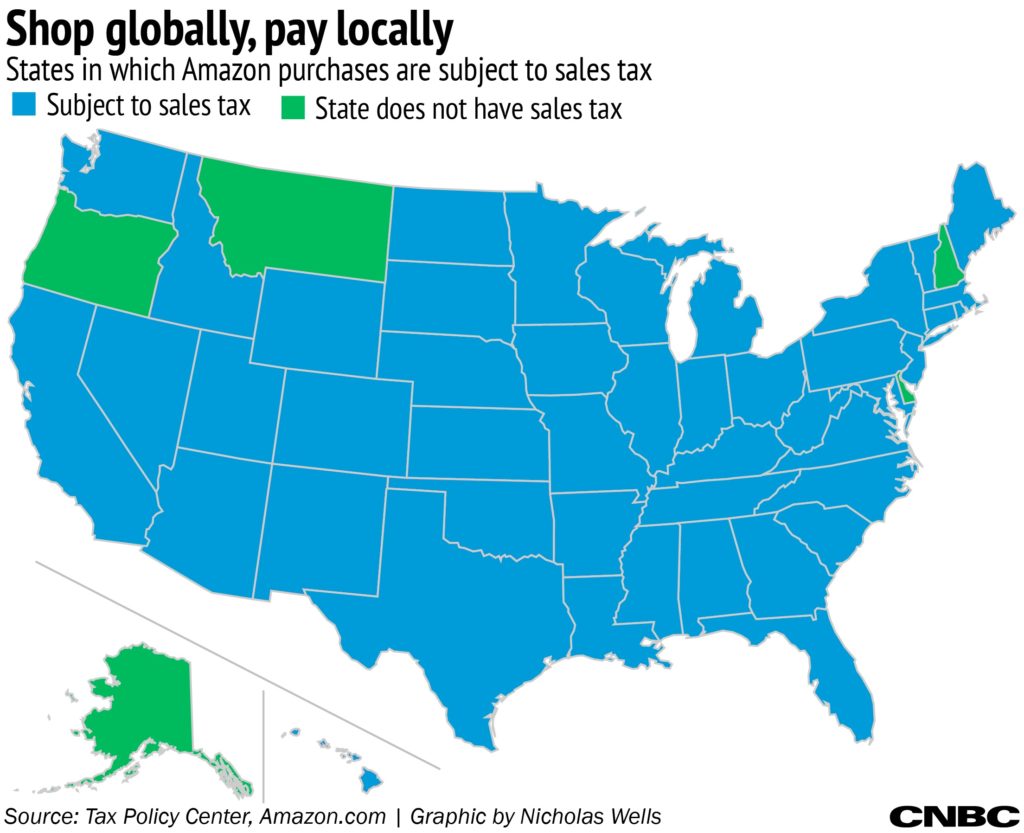
    According to CNBC, after 1 April, the only states in which Amazon won’t collect taxes are Alaska, Delaware, Oregon, Montana and New Hampshire. These five states don’t have sales levies.

    Map of US State Sales Tax Collection


    Amazon has over the years made it clear that they are not responsible for the products that are sold on their marketplace nor are they required to enforce the collection of sales tax by third party sellers.


    Continue Reading

  • Why Facebook should buy eBay

    I have been thinking about an article I read on PYMNTS regarding Facebook  and its Bay Area almnus eBay. There are a few things at play here which needs to be unpacked – who can acquire eBay, eBay’s decline and does Facebook make sense for eBay’s shareholders.

    Pierre Omidyar started AuctionWeb that would become eBay and be a shareholder darling in the early 2000’s. eBay was an catalyst that put online auctions in front of millions of customers who looked for long tail items. Items such as Omidyar’s well documented broken PEZ holders (which turned out to be a myth), stamps, baseball cards and more was the items that drove eBay’s growth. The eBay alumni are found all over the ecommerce ecosystem in various senior roles and some have become investors into ecommerce.


    Investors have been unhappy with eBay since John Donahoe took over from Meg Whitman but eBay as a commerce giant died the day they split from PayPal. Donahoe joined the PayPal board and Devin Wenig has been trying to grow a business that has lost its identity and key staff.


    Continue Reading